
Pick the rug up before you do anything else.
Sometimes the real problem isn’t the rug. It’s the floor underneath it, marked in the exact outline of the rug, somewhere between yellow and brown. Keep that in mind. It’s the only part of this job that costs real money.
Look at the back before you touch the front:
Flip a corner. If you can see the pattern from behind, the rug is woven, and the pile is part of the structure. Those rugs are tough and they can be properly washed.
If the back is a flat piece of canvas or mesh with no pattern in it, the rug is tufted. The yarn was punched through a backing cloth and glued in place, and that glue is the only thing holding the pile to the rug.
Which changes what you’re allowed to do. That latex is breaking down on its own anyway, into a gritty tan powder, and water hurries it along. The backing goes lumpy, and wet glue smells. Nothing you do on the surface reaches the glue layer. If you’ve ever owned a rug that seemed to shed sand, that was the powder. Tufted rugs get surface cleaning and nothing more.
Tufted rugs turn up at every price, so cost tells you nothing. The back takes four seconds to check and it’s the step nobody mentions.
The dirt is at the bottom, not the top:
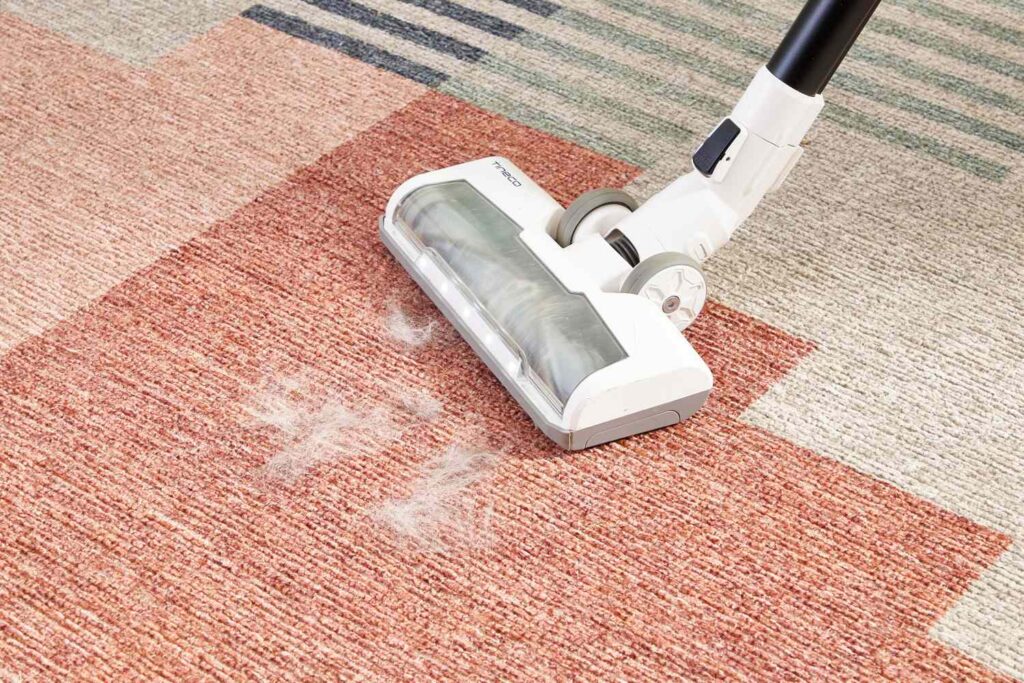
Grit doesn’t sit on top of a rug. It works down the pile and settles against the backing, exactly where your vacuum has no reach.
So flip the rug over and vacuum the back first. The vibration walks the grit down and out onto the floor. Then vacuum the floor, flip the rug, and do the front.
Better still, take it outside, hang it over a railing, and hit it with a broom handle. When we take a rug in for washing, dusting comes first, before any water touches it. A hall runner will put down a visible layer of grit on a clean floor, and the owner is always surprised.
Water, and how much you can get away with:
Test for bleeding first, especially on wool. Press a damp white cloth onto a dark area for twenty seconds. Any color on the cloth and you stop there.
A rug’s one real advantage over wall-to-wall carpet is that you can move it, so you can actually dry it. Air on both sides, laid flat on a rack or hung, and fast.
A rented machine is the wrong tool, and not for lack of power. It wets the rug where it lies, which soaks the floor underneath at the same time.
Drying a rug face-up on the floor is the usual mistake. The top looks fine within hours while the back sits wet against the boards, and that’s where mildew starts and where latex trouble gets worse.
A wool rug, an old one, or a tufted rug that already took a spill wants area rug cleaning done off-site, washed and dried flat with air moving across both faces. That’s the part you can’t reproduce in a living room.
The pad is what wrecks the floor:
Back to that stain. Vinyl and PVC rug pads, and rubber-backed rugs, contain plasticizers, the chemicals that keep them soft, and those migrate into polyurethane floor finish. You get discoloration, sometimes a tacky patch that never quite wipes off, and it’s in the finish rather than on it. Cleaning does nothing for it, and the irritating part is that the pad was sold to protect the floor.
If the mark is already there, it’s a refinishing question, not a cleaning one. The finish has to come off and go back on.
Indiana speeds the whole thing up. Wet boots put water into the rug by the door, the pad holds it against the floor, and it gets topped up again every week until March.
Use felt, or felt bonded to natural rubber. And nothing goes back down until the back of the rug and the floor underneath it are both dry.
A rug will survive almost anything you do to it. The floor under it won’t.