

It’s 11 PM. Your Basement Has Two Inches of Water. Now what?
You didn’t plan for this. One moment everything is fine — the next, you’re at the top of the basement stairs with a flashlight, looking at a floor that shouldn’t look like that, trying to decide what to do first.
Indiana homeowners know this scenario better than most. Spring storm season, freeze-thaw cycles, and aging residential infrastructure make basement flooding one of the most common home emergencies in this region — and the way most people respond to it is exactly wrong. Not through negligence. Through instinct. The instinct is to grab something absorbent and start moving water. That instinct costs people thousands of dollars they didn’t have to spend.
The decisions you make in the first hour determine the scope of the damage, the total cost of recovery, and whether the insurance claim holds together. This guide covers what to do — and what not to — in the sequence that actually matters. Basement flooding prevention doesn’t start before the storm. It starts the moment you find the water.
Before You Go Downstairs — Two Checks That Cannot Be Skipped:
A flooded basement is not primarily a water problem in the first five minutes. It is potentially an electrical problem. People have been seriously injured from not treating it that way.
Water conducts electricity. If your electrical panel is in the basement — or if you cannot confirm the submerged area contains no live outlets, appliances, or a water heater — do not step off that last stair until power to that zone is off at the breaker. If the panel itself is in the flooded space, call your utility provider to cut power at the meter. Do not guess.
Then find the source. A burst pipe has a shutoff valve — use the main supply valve if you cannot isolate it at the fixture. A sump pump failure, groundwater through the floor slab, or a storm drain backing up through a floor drain has no valve to close. Identifying the source is not optional. It determines the category of water you are dealing with, the protective measures required, and the entire framing of your insurance claim.
Once you confirm it is safe to enter, photograph everything before touching anything — water level against the wall, all visible damage, the suspected entry point. Your phone’s timestamp is part of your documentation.
The Water Category That Changes Every Decision That Follows:
The IICRC — the Institute of Inspection, Cleaning and Restoration Certification — classifies water intrusion into three categories under its ANSI/IICRC S500 standard. Most homeowners have never heard of this system. It is the most practically important information in this article.
Category 1 is clean water: a supply line failure, rainwater through a window well, a fresh appliance overflow. Category 2, grey water, carries biological and chemical contamination — washing machine discharge, dishwasher overflow. Category 3, black water, requires immediate evacuation of the affected area: sewage backup, groundwater flooding, or storm drain overflow.
In Indiana, spring flooding events routinely produce Category 3 conditions in homes with older sewer systems or basement floor drains — because when ground saturation overwhelms municipal systems, floor drains reverse direction. That water carries what the sewer carries.
Category 2 and 3 events require protective equipment, containment protocols, and antimicrobial treatment that consumer cleanup cannot adequately address. If you are uncertain which category applies, treat it as Category 2 until a professional confirms otherwise.
Document Before You Remove — Your Claim Depends on the Order:
Most homeowners get this backwards: they remove water first, call their insurer, then realize they have no documentation of original conditions. That gap is where claims get disputed, reduced, or denied.
Before any extraction begins, document the following:
- Water level against walls, stairs, and fixed structures
- All damaged contents photographed in place — furniture, appliances, stored items
- The suspected water entry point
- Any prior staining or damage predating this event
Write down the discovery time and the sequence of events. If flooding followed a storm, note the date. If a sump pump failed, photograph the pump. Insurers establish cause and scope from this record — absence of documentation creates the ambiguity that resolves in the insurer’s favor, not yours.
Standing Water Removal Is Step One — Not the Whole Job:
Once documentation is complete and the area is confirmed safe, extraction can begin. For a small, contained Category 1 event in a hard-surface utility area — a single supply line failure with minimal volume — a wet vacuum and household fans are a reasonable immediate response.
For anything larger, anything above Category 1, or anything involving a finished basement, consumer extraction equipment is inadequate. A residential wet vac holds 5 to 10 gallons before emptying. Professional truck-mounted extraction units process significantly higher volumes per hour and pull moisture from materials — not just water standing on a concrete floor.
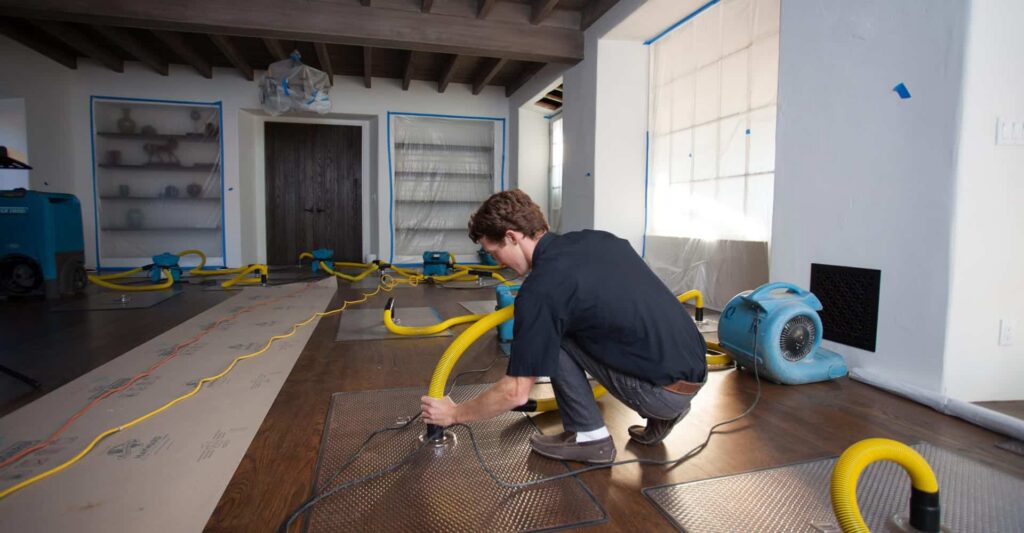
This matters because removing visible water is not drying the structure. Moisture wicked into drywall, migrated beneath flooring, and entered wall cavities does not leave through a wet vac. It requires calibrated commercial drying equipment running for days. That is what determines whether basement floods end with a repair bill or escalate into a full remediation.
The 48-Hour Basement Flooding Prevention Window You Cannot Afford to Lose:
Here is the number that should change how urgently you act: 24 to 48 hours. That is the mold colonization window the EPA documents — the period within which wet porous materials must be dried to prevent mold growth in most cases, per the agency’s official mold guidance.
In a flooded Indiana basement, those porous materials are everywhere: drywall, carpet backing, OSB subfloor sheathing, wood framing, fiberglass insulation. Every one begins absorbing water the moment flooding starts, and the IICRC S500 standard confirms that water in Class 2 events — the most common residential basement flooding classification — works up to 12 to 24 inches above the visible waterline inside wall assemblies.
A job that begins professional structural drying within 24 hours is typically a drying and cleaning job. The same job starting three days later — after waiting for an adjuster, attempting DIY cleanup, or losing a weekend — is frequently a mold remediation job with a significantly expanded scope and cost. The delay does not pause the clock. Biology runs on its own schedule.
A professional Indianapolis water remediation company uses thermal imaging and calibrated moisture meters to map exactly where water has traveled — including inside the wall assembly above the visible waterline. Equipment goes where the moisture map indicates, not where damage looks worst. Those are often different locations.
When to Call a Professional — and the One Situation Where You Probably Don’t Need To:
Most basement flooding events in Indiana warrant a professional call. Not because homeowners are incapable — because the equipment required to do the job correctly is not available at a hardware store.
Call a professional immediately if: the source is unclear or may involve groundwater or sewage, the affected area exceeds one contained room, water has reached drywall or insulation, flooding followed a storm or sump pump failure, the basement is finished, or you cannot confirm full drying within 48 hours.
DIY response may be appropriate only if: the source is confirmed clean water from a single supply line, the volume is small and entirely contained to a hard-surface utility area with no wall contact, the area can be fully dried within 24 hours with fans and a dehumidifier, and you take daily moisture readings to confirm progress.
That second scenario describes a small minority of real basement flooding events.
The restoration and cleaning services that IICRC-aligned restoration professionals provide cover extraction, structural drying, antimicrobial treatment, and post-drying verification with documentation at every stage.
Water damage cleanup Indiana professionals who produce daily drying logs, moisture mapping records, and final verification reports generate documentation that adjusters use to approve the full claim rather than a partial one.
Why Indiana Spring Fills the Emergency Call Queue Every Year:
Central Indiana’s highest basement flooding risk runs March through June, when three conditions converge: frozen ground thaws faster than drainage infrastructure can handle, storm frequency and intensity increase, and sump pumps that have been idle through winter face peak demand simultaneously.
Sump pump failure is one of the most common causes of basement flooding in northern Indianapolis suburbs. A pump not tested since the previous spring, lacking battery backup, or whose discharge line froze during a winter cold snap is a significant liability during the first major storm. Indiana Governor Braun declared states of disaster emergency covering Marion, Hamilton, and Boone counties in both March and June 2026 following severe storms and flooding events — confirmation that this risk is active, recurring, and regional.
Testing your sump pump before storm season, installing a battery backup, and clearing the discharge line are the three highest-impact water damage restoration prevention steps available to an Indiana homeowner. None require a professional. All are easier than managing the aftermath of a failure at 11 PM on a Thursday in April.
For homeowners who want a pre-season vulnerability assessment, Steamatic of Northern Indianapolis can identify specific risk factors before the storm that tests them.
FAQs:
Q1: Is it safe to enter a flooded basement?
Only after power to the affected area is confirmed off at the breaker. If the panel is in the flooded space, call your utility provider before entering. Contaminated water from sewage or storm drain backup is a separate hazard requiring protective equipment regardless of electrical safety — confirm both before stepping in.
Q2: Will homeowners insurance cover a flooded basement?
It depends on the cause. Sudden and accidental events — a burst pipe, an appliance failure — are typically covered under standard HO-3 policies. Groundwater flooding, storm surge, and overland water generally require separate flood insurance through the National Flood Insurance Program. Review your policy before storm season, not after.
Q3: How long does water damage restoration service northernindy take for a flooded basement?
Extraction runs several hours. Structural drying takes three to seven days for most residential basements, with daily moisture readings at mapped locations confirming progress. Finished basements, subfloor saturation, and mold involvement extend the timeline. The work is finished when calibrated meter readings confirm target moisture content — not when the space feels dry.
Q4: Can a regular dehumidifier handle basement drying after flooding?
A household dehumidifier processes 30 to 50 pints per day. The commercial units used in professional water removal Indiana response process significantly higher volumes daily and direct extraction into materials rather than just the air. For moisture that has entered wall cavities and subfloor layers, consumer equipment cannot achieve the drying rate the 48-hour prevention window requires.
Final Thoughts:
A flooded basement is disorienting in a specific way — the damage is obvious, the right response is not, and the margin for error is narrower than it looks. Shut off power. Find the source. Document before anything moves.
Understand that visible water removal is step one in a multi-step process, and that the EPA’s 24 to 48 hour mold prevention window started running the moment water contacted the drywall — not when you discovered it.
For Indiana homeowners facing spring flooding, sump pump failure, or groundwater intrusion, calling a professional in the first few hours rather than the first few days is the decision that keeps a bad night from becoming a water damage cleanup Indiana project nobody budgeted for.