If you came here wanting the short answer to how often to clean air ducts, here it is: every three to five years is the interval most sources land on, and for an ordinary building it’s a reasonable default. What shortens it matters more than the number. Renovation dust, water intrusion, a mold event, heavy occupancy, smoking, or pets all pull the interval in. And worth knowing: the EPA doesn’t recommend cleaning ducts on a routine schedule at all — its guidance is to clean when there’s visible mold, vermin, or substantial debris, not because a calendar said so.
That’s the honest residential answer, and most of what’s written on this subject stops there.
Now the part nobody writes for facility managers: in a commercial building, “three to five years” is close to useless as a planning number. A 40,000-square-foot office and a dental suite in the same complex are not on the same clock, and what actually sets your interval isn’t the calendar. It’s what an inspection finds.
This article covers what the interval actually depends on, what it costs to get wrong, and what to ask a bidder:
- The general three-to-five-year answer, and why it doesn’t survive contact with a commercial building
- Intervals by facility type, plus the five triggers that override any calendar
- Why duct cleaning belongs fourth in the diagnostic order, not first
Why Commercial Buildings Run on a Different Clock:
A house has a furnace, a return, and some flex duct. A commercial system has air handlers, coils, blowers, return plenums, VAV boxes, and often an economizer — a damper arrangement that pulls in outside air whenever the weather makes that cheaper than conditioning it. Your building inhales the parking lot by design. It also moves vastly more air past far more people, and you’re accountable for the result in a way a homeowner isn’t.
There’s a standard for this that duct-cleaning articles never mention. ANSI/ASHRAE/ACCA Standard 180 sets minimum inspection and maintenance requirements for commercial HVAC systems, specifically to preserve thermal comfort, energy efficiency and indoor air quality. It calls for a documented program — defined tasks, assigned responsibility, set frequencies — and treats those intervals as floors, not ceilings.
Read alongside Canada’s ACR Standard, which governs how HVAC cleaning is assessed and performed, both point the same direction: inspect on a schedule, clean on condition.
Frequency by Facility Type:
With that caveat — practitioner ranges to start a plan from, not published requirements — here’s where most buildings land.
| Facility type | Inspect | Clean |
|---|---|---|
| Professional office | Annually | Every 3–5 years |
| Medical and dental | Annually | Every 1–2 years |
| School and daycare | Annually | Every 2–3 years |
| Restaurant and food service | Twice yearly | Supply and return every 1–2 years |
| Warehouse and light manufacturing | Annually | Every 2–4 years, by process dust |
| Multi-tenant and condo | Annually | Every 3–4 years, plus at turnover |
Kitchen exhaust doesn’t belong on that list at all — it runs on its own NFPA 96 schedule and has nothing to do with the supply-side intervals above. And industrial duct cleaning indianapolis work is set by what the process produces, not by square footage. A powder-coating line and a dry-goods warehouse share a category and almost nothing else.
The Triggers That Override Any Calendar:
Reset the clock when any of these happen, whenever you last cleaned:
- Renovation or construction. Drywall dust is fine, abrasive, and goes everywhere the air goes. Clean after the work, not before.
- Water intrusion or a mold event. Wet insulation inside an air handler distributes spores.
- Tenant turnover. New occupant, new use, unknown history.
- Occupancy density changes. Doubling headcount doubles the load on a system sized for the old number.
- Visible discharge at registers. Streaking on the ceiling tile around a diffuser means material is leaving the system and landing in the room.
That last one is the only item on the list you can check today, standing in a hallway, without calling anyone.
Duct Cleaning Should Be Your Fourth Move, Not Your First:
Here’s the part that costs my industry money to say out loud: when occupants complain about the air, duct cleaning is rarely the right first move. It’s the most visible option and one of the priciest. Neither of those makes it the most useful.
The order that actually diagnoses a building:
- Filters. Rating and change frequency. Cheapest intervention available, most commonly neglected.
- The coil and drain pan. Wet, dirty surfaces sitting in the air stream generate more complaints than dusty trunk lines ever will.
- The outside air rate. A surprising amount of “bad air” is under-ventilation rather than contamination.
- Then the ducts.
One caution on filters, because conscientious facility managers get this wrong in good faith: you can’t simply install the highest-rated filter you can buy. A denser filter raises pressure drop, and a system designed around a lower rating loses airflow — which makes comfort complaints worse, not better. Upgrade to what your air handler can actually pull air through, and verify it before standardizing across the building.
What Most Quotes Leave Out:
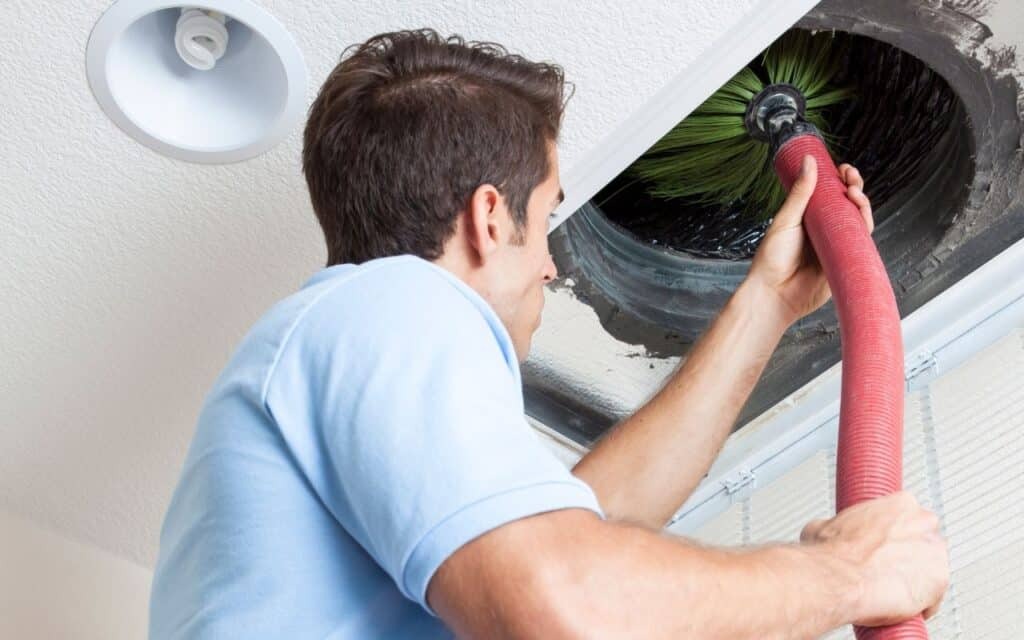
Ductwork is the part people picture and rarely the part that matters most. A legitimate scope reaches where contamination accumulates: coils, blower assemblies, air handler interiors, drain pans, return plenums. Coils matter most, and not only for air quality. A fouled coil restricts airflow and forces the system to run longer to hit the same setpoint — you pay for that twice, in energy and in equipment life. Standard 180’s own tasks include checking coil fins, inspecting for moisture carryover past the drain pan, and visually inspecting areas of moisture accumulation for biological growth.
Ask any bidder quoting commercial duct cleaning indianapolis work which of those components the price includes. If the answer is trunk lines and registers, you’re buying a fraction of the job.
How Central Indiana Loads the System:
Three seasons, three different problems, and the building only gets a break in October.
Spring pulls pollen through the economizer into filters and onto coils.
Summer adds humidity — dew points in the seventies mean condensate, and condensate on a dirty coil is how biological growth starts.
Winter seals the building; recirculating the same air through a closed envelope for months concentrates whatever is already in there, which is why the deep-winter months tend to produce the complaints that reach a facility manager’s desk. Which is why the filter schedule should tighten in spring and again in deep winter, rather than running twelve identical months.
What Occupants Complain About First:
The call comes after a pattern, not an event:
- Afternoon headaches or fatigue, concentrated on one floor
- Dust resettling within a day of cleaning
- Uneven temperatures between floors or zones
- A musty smell at morning startup that fades by mid-morning
The startup smell is the most diagnostic of the four. An odor that appears when the system kicks on and fades once air is moving usually means something is growing on a wet surface inside the equipment, not in the room.
Documentation and Scheduling:
Into the building file every time:
- Before-and-after imagery of the areas accessed
- A written scope listing which components were cleaned and which were not
- A dated record naming the contractor and technicians
That’s for the next auditor, the next insurance question, and the next facility manager. Verbal assurances are worth nothing in eighteen months.
On timing: this belongs after hours or on weekends. Air handler access means downtime, and cleaning a return plenum over an occupied floor is how you get a complaint about the company you hired to prevent complaints. Commercial hvac cleaning indianapolis crews should schedule around your occupancy, not the reverse, and price that premium as a visible line rather than burying it.
FAQs:
Q1. Does duct cleaning lower energy bills?
Coil cleaning often does, measurably. Duct cleaning alone, rarely. Anyone promising a specific percentage before inspecting your system is guessing.
Q2.Our building is new. Can we skip it?
New buildings are often the dirtiest, because construction debris has been sitting in that ductwork since the day it went in. Post-construction cleaning is its own category.
Q3. How long does it take?
A small suite, a night. A full multi-floor system, several nights staged by zone. If a duration arrives before anyone has seen your mechanical room, it’s an estimate wearing a schedule’s clothes.
Q4. How do I justify this in a budget with no complaints to point at?
Tie it to equipment rather than air. A fouled coil raises energy use and shortens the life of the most expensive box in your mechanical room, and Standard 180 gives you a recognized standard to cite. “Deferred maintenance on a capital asset” gets funded; “the air seems dusty” does not.
Q5. Is a cheaper quote ever the right call?
Sometimes — but check what components it covers first. Price gaps in this trade are usually scope gaps wearing a discount.
Final Thoughts:
The useful version of how often to clean air ducts isn’t a number at all. It’s a two-part habit: inspect annually, clean when the inspection says so, and reset the clock whenever renovation, water, or turnover changes the building. That approach costs less than calendar cleaning and defends better in a budget conversation, because every cleaning has a documented reason behind it.
It also travels.
The same logic holds whether you’re scoping commercial air duct cleaning indianapolis across a portfolio or arranging air duct cleaning carmel tenants have started asking about, and it belongs in the same maintenance plan as your carpet and office cleaning indianapolis line items rather than sitting off on its own. A walkthrough of the mechanical room and ten minutes inside one air handler tells you more than any quote will — which is where HVAC and air duct cleaning scoping should start, alongside every other commercial cleaning line you already manage.
Before you request a single quote, go stand under a supply diffuser on your worst floor and look up at the ceiling tile. If it’s streaked, you already have your answer. If it’s clean, you have a year.