

The internet’s favorite mattress trick is a spray bottle of hydrogen peroxide, dish soap, and baking soda, worked into the stain until it disappears.
It does work on the stain. It also puts water into ten inches of foam with no airflow, no sunlight, and no way to dry. In a Fishers bedroom in January, that mattress is still damp underneath on Thursday.
Almost everything worth doing to a mattress is dry.
Vacuum it like you mean it:
This is the step people skip because it feels too simple to matter. Most of what accumulates in a mattress is dry — skin cells, dust, hair, fibers — and a vacuum is the only thing that removes it rather than pushing it deeper.
Use the upholstery tool, not the floor head. Go slowly enough that you can hear the pitch change when it crosses the piping — the seams and the perimeter are where everything collects. Twice a year, pull the mattress off the frame and do the underside as well.
Spot clean with as little water as you can stand:
For sweat, urine, or blood, use an enzyme cleaner and cold water. Never hot — heat sets protein stains permanently, which is why the towel you ran through a hot wash still has the mark on it.
Spray the cloth, not the mattress. Blot from the outside of the stain inward, swapping to a clean section each time. Then dry it properly: point a fan at the spot for a few hours, crack a window if the weather allows, and don’t remake the bed until the spot is dry to the back of your hand.
You’re trading stain removal against moisture, and on a mattress moisture wins that argument every time. The same logic rules out the carpet shampooer in the garage and the steam cleaner under the sink. Both put down far more water than they take back up.
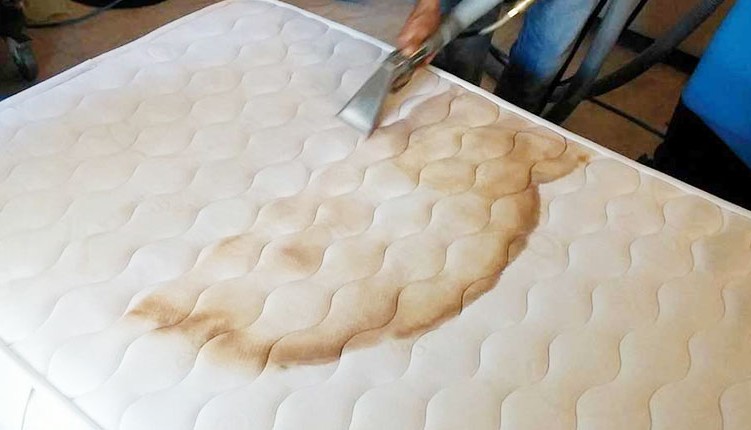
If a stain has already gone deep — an accident that soaked through, or a smell that won’t leave — a household spray isn’t the tool either. That’s low-moisture extraction, which is what furniture cleaning crews do to upholstery: pull the moisture back out under vacuum instead of leaving it in the foam.
What baking soda is good for:
It absorbs odor. That’s the whole list.
Baking soda doesn’t sanitize, doesn’t kill dust mites, and doesn’t lift anything that’s soaked into the foam. It’s still worth doing: sift a thin layer on, leave it a few hours, vacuum it off thoroughly. But people leave it overnight expecting a transformation and wake up to a lightly powdered mattress.
Look at the underside:
Once a year, tip the mattress up and look at the bottom. Hardly anyone does, and it’s the first place we look when someone calls about a smell they can’t locate.
You give off moisture all night through sweat and breathing, and it has to go somewhere. Indiana winters stack the odds against it: a humidifier running in a closed bedroom, a mattress flat on a solid platform, a cold surface underneath. Warm damp air meets a cool base and condenses where nobody looks. Grey blotching or a musty smell down there means it’s been going on for months.
Slats with one to three inches between them fix most of it, and holding the room between thirty and fifty percent humidity handles the rest. If you’re on a solid platform, standing the mattress on its side for a few hours occasionally does more than any spray.
The part that actually works:
No spray-bottle ritual changes the basic fact: a mattress cannot be washed. Everything above is damage control on a surface that can’t be laundered, and every list of mattress hacks online works around that without saying so.
The one move that genuinely works is putting something washable between you and it. A proper zippered protector costs less than a nice pillow, goes in the machine every month, and prevents most of what’s described above from happening in the first place.
Clean the mattress once. Then stop needing to.