

The water went down days ago. You ran a shop vac, propped a box fan at the bottom of the stairs, hauled the wet boxes to the curb, and told yourself you got to it in time. Then last night you noticed the drywall is still cool and damp eighteen inches up. And there’s a smell that wasn’t there on Sunday — not mildew exactly, something heavier.
That’s the ten-day mark, and in our experience it’s when a lot of water restoration indianapolis calls come in. Not during the storm. After, when the adrenaline wears off and the house starts telling you what it really absorbed. One thing decides most of what happens next. If the water came up through your floor drain rather than in through a window well, it wasn’t rainwater — it was sewage, regardless of how clear it looked. That distinction sets what can be saved, what has to go, and whether your policy pays.
This article covers what the August 1 flooding actually left behind and what to do about it ten days on:
- Water from a floor drain is Category 3 sewage no matter how clear it looked
- A combined sewer overflow and a basement backup are two different events
- The wall cavity is still wet even when the room feels dry
What Actually Happened on August 1:
A slow-moving low-pressure system parked over central Indiana. The National Weather Service recorded more rain at Indianapolis International on August 1 than fell during all of July. The 48-hour totals show where it landed hardest. South Indianapolis logged 4.87 inches, Shelbyville 5.19, Brownsburg 4.60. North-side gauges came in lower: Carmel between 2.20 and 2.40 inches, Sheridan 2.71, McCordsville 2.78, Fortville 2.12. Sit with that gap. The north side caught roughly half what the south side did, and basements up here still filled. Marion County flood reports came from Warren Park on the northeast side and an I-465 ramp closed at I-70. You didn’t need to be in the wettest part of the county to spend Sunday pumping out a basement.
Why “It Looked Clean” Doesn’t Matter:
The IICRC’s S500 standard sorts water losses into three categories, and the category — not the appearance — sets the response.
- Category 1 is clean water from a sanitary source: a supply line, a water heater.
- Category 2 is gray water carrying significant contamination, like washing machine discharge.
- Category 3 is grossly contaminated black water. Sewage, and anything it touched.
Water that rises through a floor drain has been in the sewer line. That makes it Category 3 the moment it reaches the room, whether it looked like tea or like tap water. Contamination is about origin, not clarity.
Category also degrades with time — clean water sitting in a warm basement for days is no longer Category 1. Any flood damage restoration indianapolis scope written without establishing category is guessing at the most important variable in the job.
How Sewage Reaches a Basement Floor Drain:
Older parts of Indianapolis run on a combined sewer — one pipe carrying both stormwater and sewage. Common in cities that plumbed indoors in the late 1800s, and the capacity math is unforgiving: as little as a quarter inch of rain can push a combined system past what it can carry. Citizens Energy Group’s DigIndy tunnel system — 28 miles of 18-foot tunnels bored 250 feet down under a 2006 federal consent decree — was completed in 2025 and now diverts the large majority of those overflows into treatment rather than into waterways.
One distinction is worth being precise about, because it gets blurred nearly everywhere else. A combined sewer overflow is a discharge to a river or creek. It is not the same event as water coming up your floor drain. What causes that is a surcharge — the line filling faster than it can empty. Sewage backup in basement situations happen when the water then hunts for the lowest opening in the system, usually the floor drain.
Which is why Hamilton County isn’t exempt. Carmel, Fishers, Noblesville and Westfield sit on separate sanitary sewers, not combined ones — but a sanitary line taking on groundwater and downspout inflow surcharges the same way, and water damage restoration carmel homeowners need after a storm frequently starts at the same floor drain. The mechanism differs. The basement doesn’t care.
What Has to Go, and What Comes Back:
After Category 3 contact, the dividing line is porosity.
Goes, without argument:
- Carpet and pad below the water line
- Particleboard and MDF furniture, which wicks and delaminates
- Mattresses, upholstered pieces, soft goods that sat in it
- Drywall and insulation, cut above the visible line
- Anything cardboard
Usually cleaned and returned:
- Hardwood and solid wood furniture
- Metal, glass, sealed hard surfaces
- Clothing and textiles, laundered commercially
- Electronics that stayed above the line
Proper sewage cleanup indianapolis work is decontamination with a drying project attached, which is why it follows biohazard cleanup indianapolis protocols rather than ordinary water work. Containment and antimicrobial application come first, and the water extraction indianapolis crews perform on a Category 3 loss isn’t the same procedure as a clean-water pull. It shouldn’t be priced like one.
When You Don’t Need to Call Anyone:
Worth saying plainly, since almost no restoration site will: not every wet basement is our job.
Clean water, small area, caught inside 24 hours, no carpet and no finished walls — a wet vac and two days of air movement genuinely handles that. Plenty of homeowners did exactly the right thing on August 1.
Three things change the answer: Category 3, finished space, or time. Sewage is contamination you can’t verify by eye, finished space hides cavities you can’t reach, and ten days means the decision already got made for you.
What’s Happening Behind the Drywall Right Now:
If you pumped the water out and stopped, here’s what’s happening behind the drywall right now.
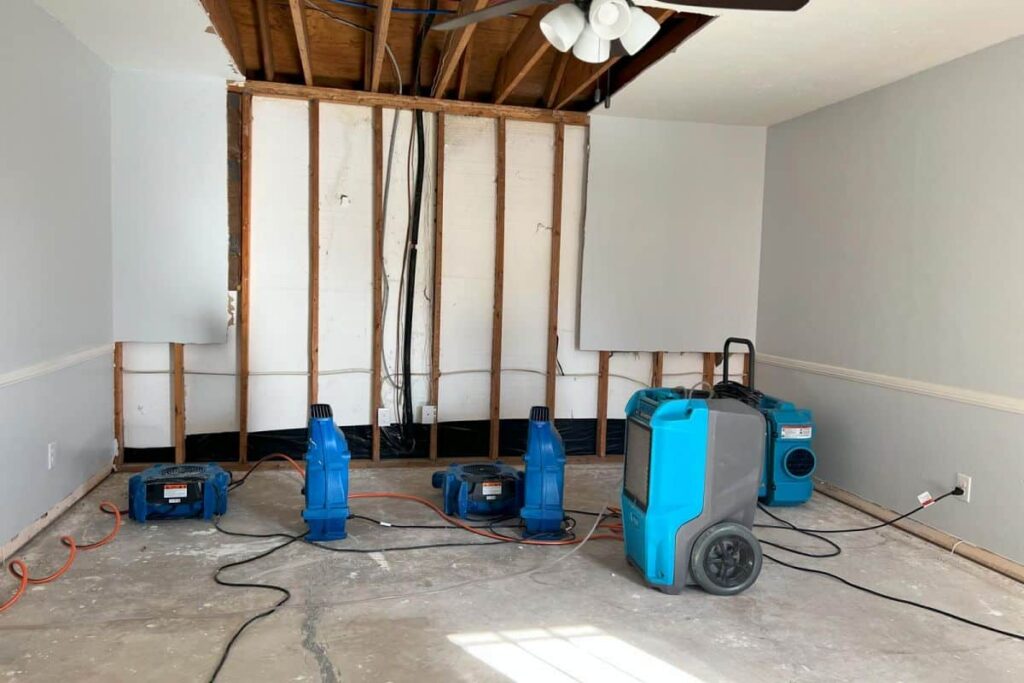
Moisture wicked up inside the cavity past the visible line. The paper facing on that drywall is cellulose — damp now, warm, and contaminated. Insulation is holding water against the framing. Under a finished floor, the subfloor has nowhere to release what it took on.
The smell is the tell. Microbial activity in materials that were never dried produces it, and it won’t fade on its own because the source is still wet. A dehumidifier in the middle of the room treats the air, not the cavity.
Emergency water restoration at this stage means opening walls and taking meter readings, not setting equipment and leaving. Ten days in, the question isn’t whether the room feels dry. It’s whether the assembly is — and a room can feel perfectly dry with eight inches of saturated cavity behind the paint.
Check the Declarations Page Before You Assume:
This is the paragraph that costs people the most money.
Standard homeowners policies typically exclude two things at once: surface flooding, which needs separate coverage through FEMA’s National Flood Insurance Program, and sewer or drain backup, normally excluded from the base policy outright. What covers a backup is usually a specific add-on — a sewer backup or water backup endorsement, often carrying its own sublimit well below your dwelling coverage. Don’t assume it’s there because you have “good coverage.” Pull the declarations page and look for that endorsement by name.
Read Anything You’re Asked to Sign
Restoration trucks work flooded neighborhoods door to door. Most of those companies are fine. The paperwork is where to be careful. You’ll likely be handed a work authorization, often with a direction to pay or an assignment of benefits alongside it. That second document can give a contractor the right to bill your carrier directly and negotiate the claim in your place. Sometimes convenient. Sometimes you’ve signed away your seat at the table on a claim with your name on it.
Nobody in this trade enjoys writing that paragraph. Ask what each form does, and don’t sign the second because the first was reasonable.
Document Before You Clean
- Photograph the water line on every wall before anything is cut
- Date-stamp everything, inside and out
- Keep removed materials — bagged and outside, but kept — until an adjuster has seen them
- Save receipts for pumps, fans, dumpsters, anything bought in week one
Adjusters price what they can verify. Material hauled off on day two is material you’ll describe from memory.
Renters and Landlords:
In Marion County the split is usually clean: the landlord’s policy covers the structure, the tenant’s covers their belongings. Neither automatically covers sewer backup without the endorsement, which is how both parties end up surprised at once.
Tenants: report in writing, keep the timestamp, photograph your belongings before anything leaves the unit. A verbal report to a property manager on a Sunday is worth very little in November. Landlords carry the habitability obligation, and a Category 3 loss in an occupied unit isn’t a repair that waits for a convenient week.
Before the Next One:
- Backwater valve — the only device that actually stops a surcharging sewer at the house. Permit and licensed plumber required.
- Sump pump with battery backup — storms take the power out, which is precisely when the pump matters.
- Downspout extensions, four feet minimum off the foundation.
- Nothing valuable on the floor. Shelving and pallets, not cardboard on concrete.
FAQs:
Q1. The water looked clear. Is it really Category 3?
Yes, if it came through a floor drain or sewer line. Category is set by where the water has been, not what it looked like.
Q2. Is it safe to be in the house?
Generally yes, if the water stayed in the basement. Keep children and pets off affected flooring until it’s cleaned and dried, run the dehumidifier with the basement door closed rather than circulating that air upstairs, and anyone with asthma or a compromised immune system should stay out until it’s remediated.
Q3. Can I just use bleach?
On a small, hard, non-porous surface, sometimes. It doesn’t penetrate porous materials, doesn’t dry a wall cavity, and doesn’t produce the documentation a claim needs.
Q4. How long should drying take?
Three to five days once equipment is set correctly. Ten days after the fact, that clock starts when the wet material comes out.
Q5 Will insurance cover mold that shows up later?
Sometimes, if it traces to a covered sudden event and you acted promptly. Gaps between the loss and the response are where claims die.
Final Thoughts:
The homes that come out of this worst won’t be the ones that took the most water on August 1. They’ll be the ones where somebody pumped the basement, ran a fan over the weekend, and assumed dry air meant a dry wall.
If water came up through your floor drain, treat it as contaminated and get a meter on the walls. Competent water restoration indianapolis work starts with readings and a category determination rather than a phone estimate, and 24/7 emergency response covers North Indianapolis, Carmel, Fishers, Noblesville and Westfield — which is what restoration cleaning is for.
Before you call anyone, go downstairs and press your palm flat against the drywall a foot above where the water stopped. If it’s cooler than the wall beside it, the cavity is still wet, and everything above still applies.