
The scissors are right there, and they’d solve this in four seconds. That’s the whole problem.
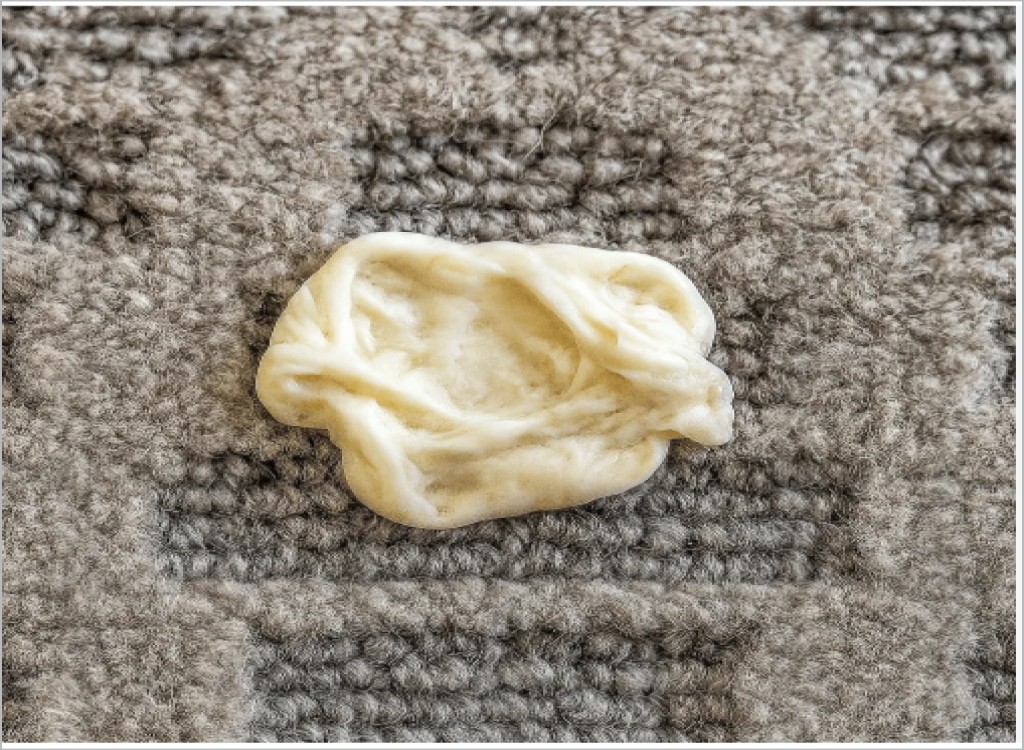
The carpet pile is a fixed length. Snip a tuft and nothing grows back — you’ve traded a sticky spot for a shallow crater that catches the light for the rest of the carpet’s life. Gum comes out. A cut doesn’t grow in.
Cold, not heat:
Chewing gum base is a synthetic rubber, and like most rubbers it goes brittle when it’s cold and stretches when it’s warm. That’s the entire strategy.
Ice cubes in a zip bag, pressed onto the gum for ten to fifteen minutes. You’re waiting until it’s hard enough to tap with a fingernail and hear a click rather than feel a give. Then work it, don’t pull it. Tap the frozen lump with the back of a spoon to crack it, then lift the pieces out with the edge of a dull knife, starting at the outside and moving in. Pulling from the center stretches whatever hasn’t frozen through and drags it deeper between the fibers.
If it starts going soft before you’re done, stop and re-freeze. Three cold rounds beat one warm one. Gum that’s already been walked on is the same job with more patience. It spreads sideways rather than down, so freeze a wider area than the mark looks and work in from the edges. Plan on three or four rounds, and expect far more residue than a lump leaves.
Heat is the other approach, and on a hard floor it’s fine. On carpet it makes the gum stringier and drives it toward the backing, and sustained heat is hard on synthetic fiber and carpet backing alike. There’s no reason to take that trade.
The gray film underneath:
Get the lump out and you’ll usually find a dull, slightly tacky patch where it sat. That’s the residue — the plasticizers and polymer that soaked into the fiber surface — and freezing does nothing to it.
It needs a solvent, because gum base repels water. A citrus-based cleaner with d-limonene in it is the right tool and costs very little. Apply it to a white cloth rather than the carpet, press for thirty seconds, then blot from the outside in. That’s safe on nylon and polyester. On wool, skip it and use a little dish soap in cool water instead — most shelf gum removers are largely petroleum distillate behind the citrus, and wool discolors.
Oil does the same job, which is why the peanut butter trick keeps circulating. It genuinely works, but you’ve then got a grease stain on your carpet, which is a worse problem than the one you started with. If you go that route, follow it with a teaspoon of dish soap in warm water and expect several passes.
Finish with plain water blotted through, and dry it fast. Solvent left in the pile keeps working after you’ve stopped.
If someone already cut it:
A fair number of people get here one snip too late.
You can sometimes disguise a small cut. Work the surrounding pile with your fingers to lift and fluff it over the gap, then vacuum against the lean of the traffic pattern. Low-pile carpet hides a trim better than plush does, and a spot under furniture may never be noticed.
A real divot is a repair, not a cleaning job. The standard fix is a bonded plug — a circle cut from a remnant or from inside a closet and glued in. Done carefully it disappears. The ones we get called to redo are almost always the ones somebody hurried. Worth knowing before you call anyone: if the spot is also in a traffic lane, carpet cleaning is worth doing at the same time. A patched or freshly cleaned circle surrounded by three years of foot traffic reads as a mark from across the room even when the repair itself is perfect.
Warm gum smears and cold gum breaks. That’s the only clock that matters here — not how fast you move, but how cold it is when you start. Which leaves just the drawer with the scissors in it, and the decision not to open it.