
Stand in your lobby and look down. The tile has a grey cast to it — not dirty exactly, just flat, like it’s under a film. The restroom floor gets mopped every night and looks worse than the tile in the storage room nobody touches. Then look at the grout. If you’ve been in the building a few years, picture what those lines looked like when you started. Probably a light sand color. They’re brown now, and nobody noticed, because it happened a quarter-shade at a time.
The uncomfortable part, and the reason facility managers start searching for tile and grout cleaning near me in the first place: that floor doesn’t look bad despite being mopped nightly. It looks bad partly because of it. That isn’t a knock on your janitorial crew. They’re doing the job they were hired to do with the tools that job comes with. A mop is a maintenance tool, and maintenance and restoration are different things. Confusing them turns a five-year-old floor into one that looks fifteen.
This article covers why a nightly-mopped floor still looks dull, and how to tell what you’re actually dealing with before you take a quote:
- Mop water redeposits soil and packs it into grout, which sits below the tile plane
- A free hot-water test separates cleaner residue from real soil
- Restoration resets the floor; your janitorial crew keeps it that way — you need both
What a Mop Actually Does After the First Few Passes:
A mop doesn’t remove soil so much as relocate it. Three things happen on a nightly cycle:
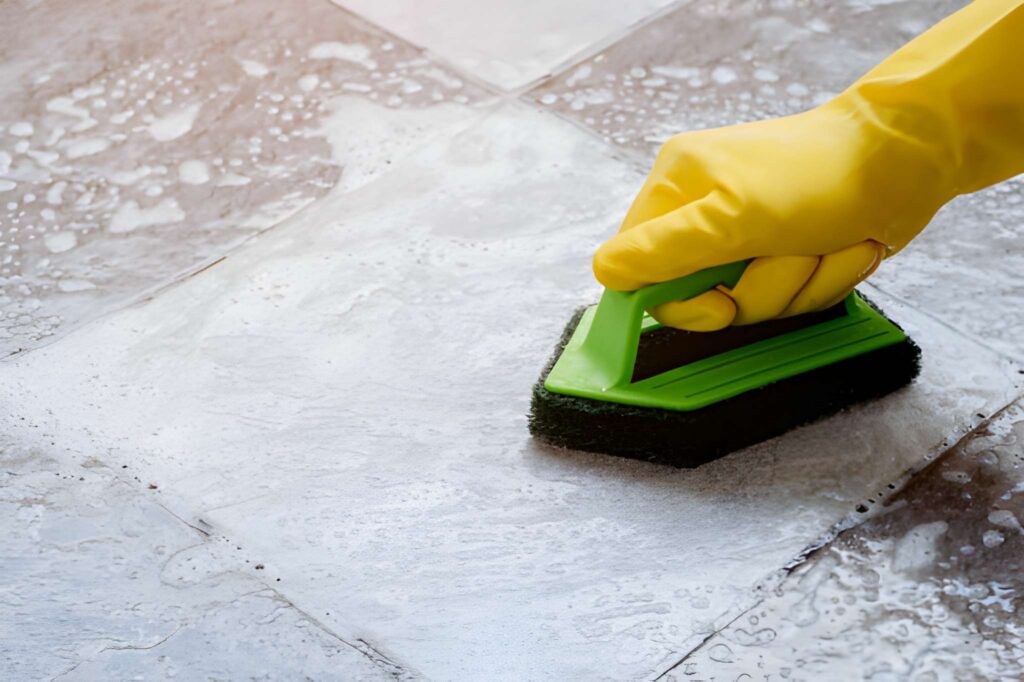
The water becomes the problem. After a few hundred square feet, the bucket holds a dilute solution of everything that was on the floor. Every pass after that spreads thinned dirt evenly and leaves it to dry. That grey film is the residue of the floor’s own cleaning.
The mop pushes soil into the grout. Grout sits a millimeter or two below the tile plane, so the mop head rides the tile and packs slurry down into the low channel, where it dries.
Wrong-pH products strip protection. Cleaners that are too alkaline, or acidic bathroom products used on the wrong surface, break down finishes and sealers over months. Once that layer is gone the floor absorbs soil faster — which prompts more aggressive cleaning, which removes more protection.
Try Hot Water First — It Might Be Residue, Not Dirt:
A test worth running tonight, and one that sometimes means you don’t need us at all.
Take a clean mop, plain hot water, no product, and go over a two-foot square of the dullest tile you have. Rinse the head, repeat. If that patch comes up noticeably brighter than the tile around it, you don’t have a soil problem — you have a residue problem. Surfactant film from products that were never rinsed off, and the fix is your dilution ratio and a rinse step, not a restoration.
The same logic applies if your building runs an autoscrubber. A machine that lays solution down and doesn’t pick it all back up does what a dirty mop does, only faster and across more square footage — and the usual causes are worn squeegee blades or a recovery tank that isn’t being emptied properly. Check both before you assume the floor needs service.
If the hot-water patch looks identical to everything around it, the soil is in the grout. Keep reading.
Grout Is What Your Eye Is Actually Reading:
People say “the tile looks dirty.” Usually the tile is fine and the grout is the problem.
Standard cement-based grout is porous by design — a network of tiny voids sitting in the lowest part of the floor, where water, soil and cleaning residue all collect. Dark grout against clean tile reads as a dirty floor to anyone walking through, which is why grout cleaning Indianapolis work delivers more visible improvement per dollar than anything you can do to the tile itself.
A second test, and this one tells you about the seal rather than the soil. Put a drop of water directly on grout in a traffic lane. If it beads, the seal is intact and whatever you’re seeing sits on the surface. If it soaks in within a few seconds, the seal is gone and soil has been working into the grout body for a while.
What Restorative Cleaning Does Differently:
A mop moves soil around at the surface. Restorative equipment removes it from the floor entirely.
Hard-surface systems combine heated solution, controlled pressure and immediate vacuum recovery. Pressure drives solution into the grout’s pores, and extraction pulls the suspended soil and the dirty water off the floor in the same pass, so nothing is left to dry.
That last part isn’t achievable with a bucket at any frequency. You can mop a floor nightly for a decade and never once remove what’s sitting inside the grout. Effective tile cleaning Indianapolis work is defined by what leaves the building, not how often someone passes over the surface.
Four Surfaces That Need Four Different Things:
Most buildings run several floor types, and the worst outcomes come from treating them the same.
- Ceramic and porcelain tile. The most forgiving surface you own — handles heat, pressure and extraction well. Grout is the variable, not the tile.
- Natural stone and marble. The Natural Stone Institute is clear that calcareous stone is largely calcium carbonate and sensitive to acidic solutions, so mild non-acidic cleaners are what it calls for. Dull marble usually needs mechanical honing and polishing rather than stronger chemistry — which is what marble polishing Indianapolis actually refers to.
- Hardwood. The National Wood Flooring Association advises against wet mops and steam mops, which damage the finish and the wood over time. Serious hardwood floor cleaning in Indianapolis work means dry soil removal, minimal moisture, and recoating when the finish dulls.
- VCT. Needs stripping and refinishing on a cycle. The failure mode is build-up, not wear.
The Mistakes That Cost Real Money:
- Acidic cleaner on marble. Etching is physical damage to the stone surface, not a stain, so no amount of cleaning or sealing reverses it. Correcting it means honing and repolishing the affected area.
- Steam on hardwood seams. Moisture in vapor form finds board edges and joints, and what it does there isn’t reversible with a recoat.
- Wax nobody has stripped in five years. Each coat goes over the last, trapping soil in amber-colored layers. Floor stripping and waxing near me searches usually start when the floor has gone yellow and nothing shines anymore.
- Sealing over dirt. The most expensive error on this list, because it works. The sealer does its job and locks the soil into the grout permanently. Sealing is the last step, never the first.
- Color-sealing a traffic lane. Color-sealing coats the grout in pigmented sealer, and in a lobby or corridor it looks excellent for about a year, then wears through unevenly and gets harder to correct than the original problem. It has real uses. An entry lane isn’t one of them, and if it’s the first thing a bidder proposes, ask why.
This Sits Alongside Your Janitorial Contract:
Let’s be direct about the thing that actually decides the budget line: this does not replace your cleaning crew, and you shouldn’t let anyone sell it to you that way. Daily janitorial services Indianapolis buildings rely on to do the maintenance: soil removal, spills, appearance between services. That work keeps a restored floor looking restored. Periodic restorative service does the reset if your crew has no equipment to perform.
Neither substitutes for the other. A building with a good janitorial contract and no restoration ends up where this article started. One that restores and then neglects daily care wastes what it just spent.
Sealing, and How Long It Holds:
Sealing after cleaning is worth it on cement-based grout. It buys time before soil starts working into the pores again. Expect less life than the label suggests, though. Three-to-five-year claims assume residential traffic. In a commercial entry or corridor, reassess annually and plan on resealing every year or two depending on traffic and what your cleaning chemistry is doing to it. Use the water-drop test, not the calendar.
Restore, or Replace?
Sometimes the honest answer is replacement, and you deserve to hear it before you pay for a restoration that can’t deliver.
Restoration usually works when tile is sound, grout is intact but discolored, and the problem is accumulated soil.
Replacement is the better spend when grout is cracked or missing in sections, tiles are loose or sound hollow underfoot, moisture is coming from below, or the grout has been dyed or sealed over heavy soil more than once.
Anyone who quotes a restoration without checking for loose tile is selling you a temporary improvement on a failing floor.
FAQs:
Q1. How often does a commercial floor need this?
Most buildings land between annually and every two years for traffic areas, with entries and restrooms more often. Condition drives it, not the calendar.
Q2. Can my janitorial team just use stronger chemicals?
That usually accelerates the damage. Stronger products strip finish and sealer faster, and the floor absorbs soil more quickly afterward.
Q3. Will this fix grout that’s a different color than it used to be?
Often yes, if the color changes to soil. If the grout was sealed over dirt or previously dyed, expect partial improvement and ask for a test patch first.
Q4. How long is the floor out of service?
Most tile and grout work is walkable within a couple of hours of the last pass, so an overnight job is open for business the next morning. Stripping and refinishing VCT needs longer for cure time — plan that one for a weekend or a holiday closure.
Q5. Does the work have to happen overnight?
For most spaces, yes, and any reasonable provider schedules around your hours rather than yours around theirs.
Final Thoughts:
A mop maintains a floor. It was never going to restore one, and no increase in frequency changes that. If your grout has quietly gone three shades darker, that’s soil sitting below the tile plane where a mop head can’t reach it, and it will keep darkening until something pulls it out.
Whether you’re pricing tile and grout cleaning fishers businesses need or hard surface work across a portfolio, start with the hot-water patch and the water-drop test before you take a single quote. A proper hard surface cleaning assessment covers Indianapolis, Carmel, Fishers, Noblesville, Westfield and Zionsville, and slots into your existing commercial cleaning plan rather than competing with it.
Then go stand in your lobby and try to remember what color that grout used to be. If you can’t, it’s been too long.